Our Kaitiakitanga work programme

At Wellington Airport we are deeply conscious of our responsibilities to our people, community, and wider environment. Our Kaitiakitanga work programme embeds this into everything we do.
For us, it is more than just talk. We have a range of specific targets for reducing our environmental footprint, and we measure and report our performance annually.
Equally important is our contribution to the Wellington community and New Zealand economy, and the people we employ.
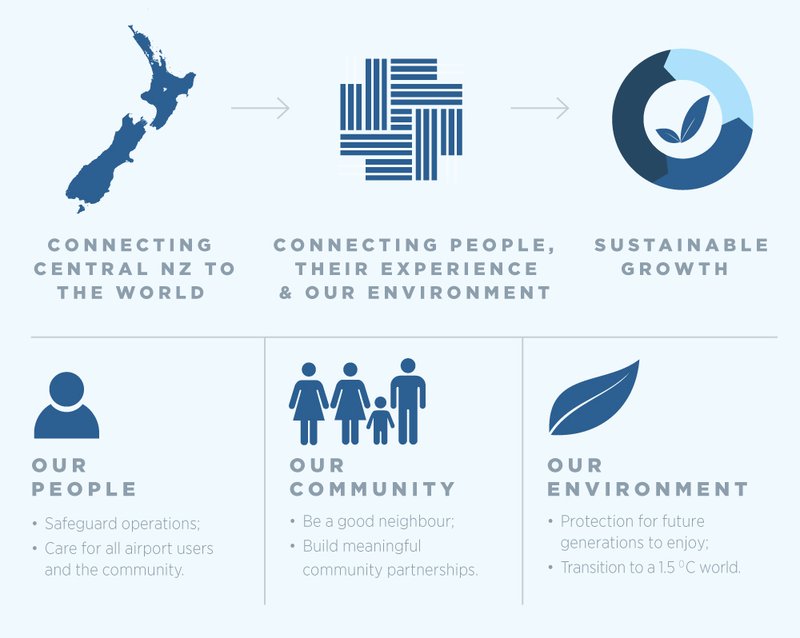
Reducing our footprint is an essential challenge of our business given how vital aviation is to Wellington and New Zealand.
As the international gateway for Central New Zealand, we connect people with loved ones and support thousands of businesses across our region. In a typical year Wellington depends on its airport for 14,500 jobs, $2 billion in economic output, and around six million passenger journeys.
2030 TARGETS
We have four key 2030 targets to reduce our environmental footprint and focus our work where we can make the best impact. Further details on how we will meet them and our results so far are outlined in our sustainability reports
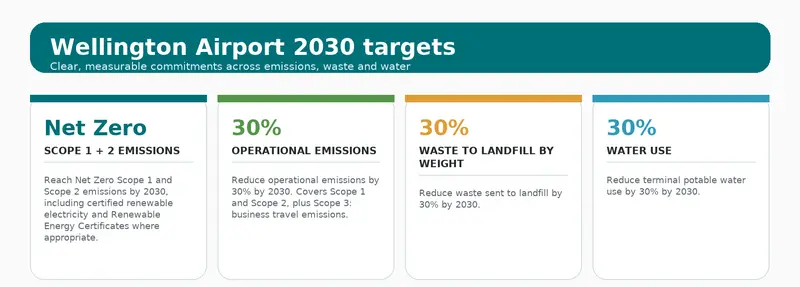
Additionally, we are committed to maintaining Net Zero in Scope 1 & 2 beyond 2030 and supporting the achievement of Net Zero in Scope 3 by 2050.
Our key steps to achieve emissions reductions, in consultation with airline partners, include:
- Tracking against transparent, science-based targets
- Improving the efficiency of heating, cooling and lighting systems
- Prioritise replacing our gas boilers and moving to 100% renewable energy sources
- Replacing our vehicle fleet with electric vehicles
- Purchasing certified renewable electricity and Renewable Energy Certificates where appropriate
- Offsetting residual emissions using high-quality local native forest offsets with biodiversity co-benefits, including protection of native forest areas from pests and invasive species
Some of our achievements so far include:
- Achieving Level 4+ (Transition) Certification from the Airport Carbon Accreditation programme.
- Scored 98/100 for performance and management of environmental, social, and governance by GRESB assessment.
- Converting $100 million of bank facilities into sustainability linked loans.
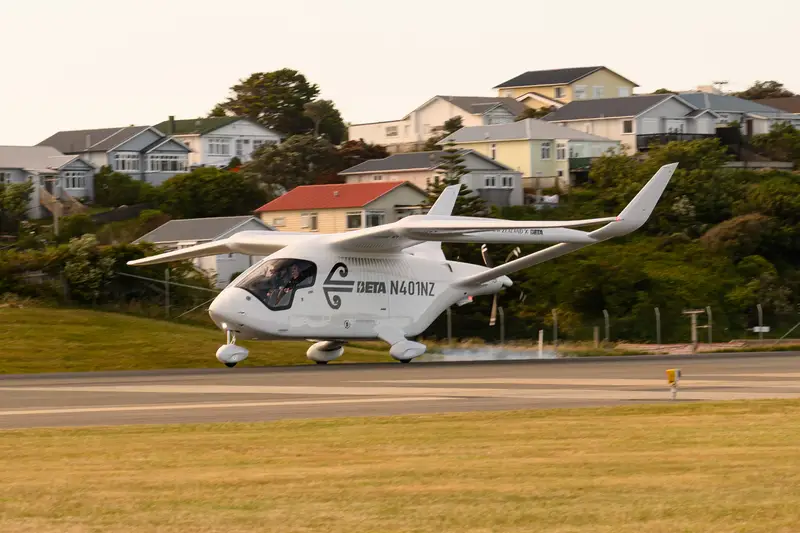
- Partnering with Air New Zealand and Marlborough Airport to advance electric aviation in New Zealand. Wellington Airport successfully hosted the BETA ALIA CTOL demonstrator aircraft in 2025, providing a practical trial of electric aircraft operations. Building on this, Wellington Airport is preparing to host Air New Zealand's first commercial electric aircraft service, together with Marlborough Airport.
- Reducing energy use through terminal optimisation, LED lighting replacements and improvements to heating, lighting and cooling systems.
- Overhauling the in-terminal bin system to make it easier for passengers and tenants to separate waste correctly and reduce waste to landfill.
- Creating our community garden in Rongotai to recycle food waste into compost.
- Improving our public transport options and enhancing biking facilities.
- Partnering with Trees that Count and Predator Free Wellington to support biodiversity in the both Miramar Peninsula and throughout Aotearoa.
- Supporting our airline partners in initiatives to reduce their fuel consumption and carbon emissions. This includes hosting the first-ever trial of hydrogen at a New Zealand airport, welcoming our first shipment of Sustainable Aviation Fuel (SAF), and participating in the New Zealand Sustainable Aviation Fuel Industry Roundtable.
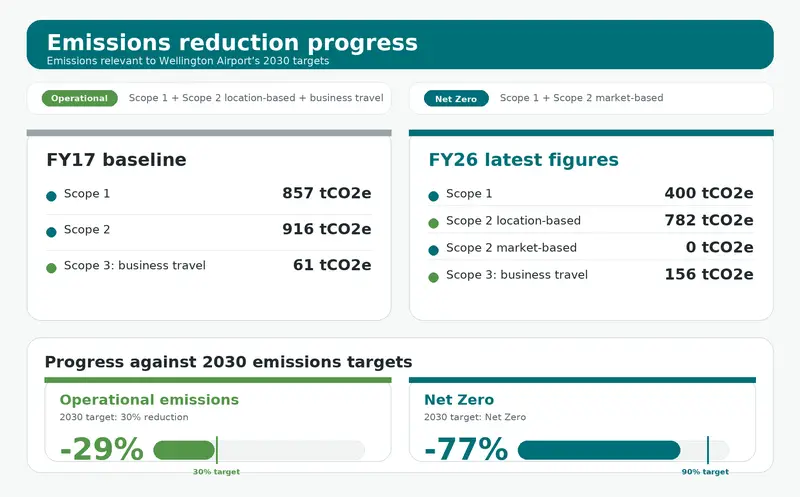
Emissions monitoring
Wellington Airport continuously monitors the emissions generated from our airport precinct, including the operation of our own infrastructure, electricity use, and processes.
You can find detailed reporting of these emissions and our climate-related disclosures in our sustainability reports.
Governance and oversight of sustainability
Our Board maintains accountability and oversight of the Airport’s ESG (Environmental, Social and Corporate Governance) developments.
At a management level, the Airport’s Executive team has day-to-day responsibility for identifying and managing climate-related risks and opportunities.
ESG work programme development is the responsibility of the Sustainability Manager, in partnership with the Executive Team. Progress and workstreams are coordinated and monitored through the Executive Kaitiakitanga Committee. The Kaitiakitanga Committee meets monthly to track progress against key initiatives and targets.
The Board receives regular reporting and updates from the Executive-led Kaitiakitanga Committee, Sustainability Manager and Corporate Affairs team.
Alongside reporting from the Executive Team, our Board has regularly sought views from external experts.
The Board frequently reviews the Airport’s approach for ESG management, and ESG criteria are included in Executive incentive schemes.
The Board regularly reviews ESG risks and Climate-related risks via the Audit and Risk Committee.